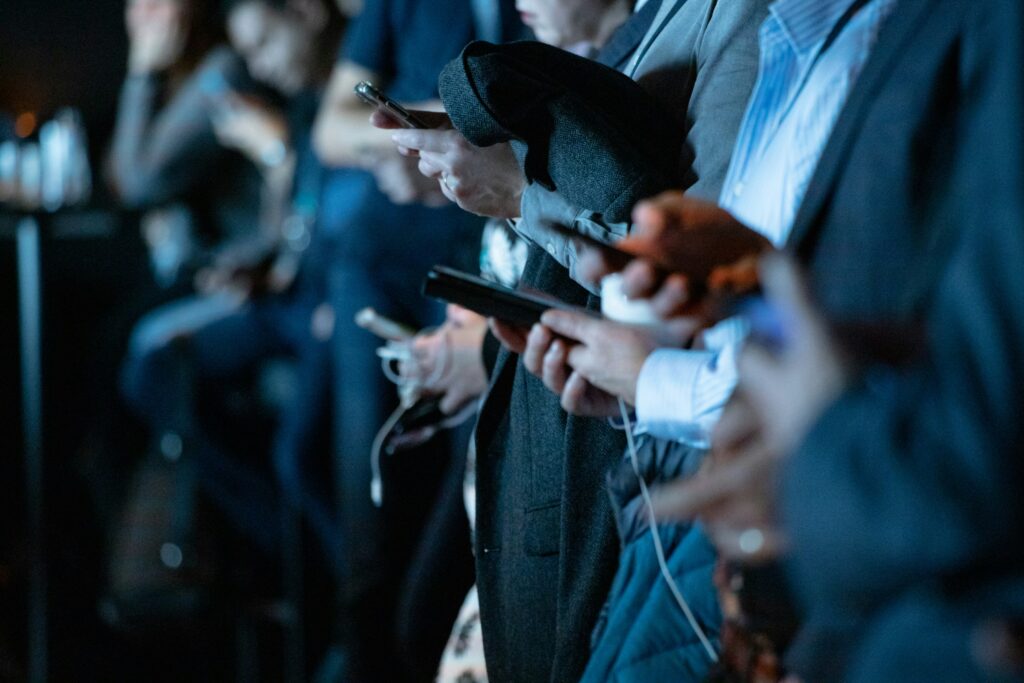
Photo by camilo jimenez on Unsplash
How diverse is your PLN?
Before taking this course, I always thought my PLN was relatively diverse. I followed people from different professional fields and was exposed to various perspectives, so I didn’t question its “diversity” much at the time. However, after watching Shelley Moore’s content on “Inclusion is not assimilation,” I realized I hadn’t fully understood what a PLN entails. (Moore)
For instance, in my daily use, I do follow content creators from diverse backgrounds. Yet I noticed they often employ similar language and share remarkably similar narratives. Whether sharing career experiences on LinkedIn or discussing learning on YouTube, most content follows strikingly similar success paths and standardized processes. This content is more likely to be recommended by platforms, continuously appearing in my feed. Conversely, content that doesn’t fit this pattern receives fewer recommendations, leaving me with little chance to discover it.
How does social media engage communications?
After reading the perspectives in Media & Social Justice, I believe social media has transformed the way public communication occurs, making it more free and accessible. Compared to traditional media, social media lowers the barrier to participating in public discourse, enabling individuals to move beyond being mere recipients of information. Instead, they can express their views, respond to others, or establish connections within the public sphere. (Clark and Aufderheide)
Furthermore, I’ve discovered that social media expands learning possibilities within Personal Learning Networks. For instance, discussion forums, comments, and sharing features on Brightspace transform learning from classroom-bound activities into an ongoing interactive process. I not only access specialized knowledge but also observe how others interpret and respond to content, thereby strengthening my own perspectives.
Also, on platforms like YouTube or MathLab, when I watch learning-related videos or posts, I can see others sharing different interpretations or highlighting important points in the comment sections. We can even reply directly to each other. This interaction makes me realize that communication is no longer a one-way transmission of information, but an ongoing exchange.
How does social media challenge communications?
After watching Obama’s speech at Stanford, I realized that while social media accelerates information dissemination, it also reduces the time people spend verifying and comprehending information. This observation resonates with my personal experience. Faced with a deluge of rapidly updated content, people are often drawn to emotional or strongly opinionated viewpoints rather than delving into the context of events.
Though social media enhances communication efficiency, it may simultaneously diminish communication quality, necessitating more cautious engagement. For instance, when Dr. Yuan Longping of China was critically ill, Chinese microblogging platforms mistakenly reported his death. Nearly everyone believed the news, and it spread wildly across Chinese networks. Only after Yuan Longping’s team personally issued a statement did people realize the news was false.
Reference:
Clark, J., Aufderheide, P. (2011). A New Vision for Public Media. In: Jansen, S.C., Pooley, J., Taub-Pervizpour, L. (eds) Media and Social Justice. Palgrave Macmillan, New York. https://doi-org.ezproxy.library.uvic.ca/10.1057/9780230119796_5
Moore, Shelley. One Without the Other : Stories of Unity Through Diversity and Inclusion, Portage & Main Press, 2016. ProQuest Ebook Central, https://ebookcentral.proquest.com/lib/uvic/detail.action?docID=4832579.
Obama, Barack. President Obama Addresses Disinformation. YouTube, uploaded by Stanford University,