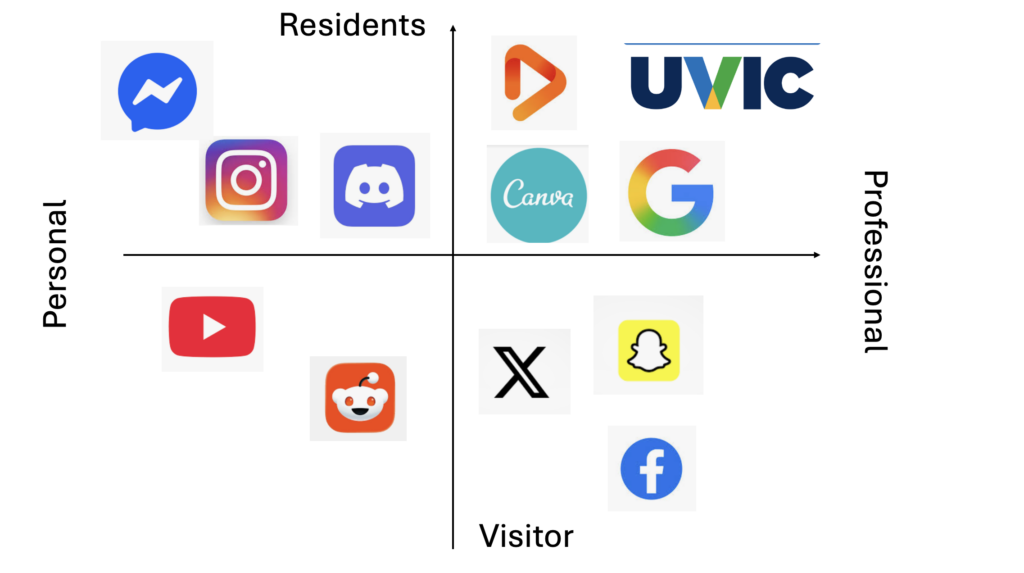
What digital platforms are students currently using to develop their professional network?
I believe most students currently rely on LinkedIn to build and maintain their professional networks. As an authoritative platform, LinkedIn is frequently used by companies to review student profiles. On LinkedIn, students can showcase their academic backgrounds and project experiences while connecting with corporate HR professionals.
Beyond this, I believe learning-related platforms—such as Uvic’s Brightspace, Discord, or other interactive learning platforms—also support professional relationship building. While not job-focused like LinkedIn or Indeed, these platforms enable students to establish connections within their professional interests through collaborative discussions and task completion.
What could the student consider in expanding their professional learning network?
I believe that when expanding their professional learning network, students shouldn’t constantly seek out new platforms. Instead, they should focus more on how they engage within existing platforms. Often, students consume vast amounts of information but remain largely at the level of browsing and receiving content, with little genuine interaction.
For instance, on platforms they already use, students can try shifting from passive viewing to light interaction—such as leaving simple comments, sharing learning outcomes, or responding to others’ perspectives. This shift from “mere usage” to “leaving traces” aligns with the Visitor and Resident mapping concept (White & Le Cornu, 2011).
How might employers perceive your digital identity if they assess it through social media?
If employers review my social media and digital identity, they likely see only a fraction of my online activities. My digital identity reflects only the aspects I choose to present publicly, while substantial learning efforts remain largely invisible.
Conversely, on platforms where I engage more actively—such as GitHub, Mathematics Stack Exchange, or course-related learning spaces—employers might observe my professional side. Digital content is often interpreted differently by various audiences across contexts (Regan & Jesse, 2019). For instance, a seemingly casual post on Facebook might be unexpectedly interpreted by an employer as unprofessional, potentially influencing their judgment of my work ethic. Conversely, ordinary school assignments might be perceived by employers as evidence of professional competence.
This has made me realize that digital identity is not entirely within an individual’s control, it gradually takes shape through others’ viewing and interpretation.
Reference:
Regan & Jesse (2019)
Regan, Priscilla M., and Jessica Jesse. “Ethical Challenges of EdTech, Big Data and Personalized Learning: Twenty-First Century Student Sorting and Tracking.” Ethics and Information Technology, vol. 21, no. 3, 2019, pp. 167–179.
White & Le Cornu (2011)
White, David, and Alison Le Cornu. “Visitors and Residents: A New Typology for Online Engagement.” First Monday, vol. 16, no. 9, 2011,
https://firstmonday.org/ojs/index.php/fm/article/view/3171/3049.